Skip To Main Content

About Austin Texas

Info From Wikipedia

Austin is the capital city of the U.S. state of Texas and the seat of Travis County. Located in Central Texas on the eastern edge of the American Southwest, it is the fourth-largest city in Texas and the 13th most populous city in the United States. It was the third-fastest-growing large city in the nation from 2000 to 2006. Austin has a population of 790,390 (2010 U.S. Census). The city is the cultural and economic center of the Austin–Round Rock–San Marcos metropolitan area, which has a population of over 1,716,291 (2010 U.S. Census), making it the 35th-largest metropolitan area in the United States.

The area was settled in the 1830s on the banks of the Colorado River by pioneers who named the village Waterloo. In 1839, Waterloo was chosen to become the capital of the newly independent Republic of Texas. The city was renamed after Stephen F. Austin, known as the father of Texas. The city grew throughout the 19th century and became a center for government and education with the construction of the Texas State Capitol and the University of Texas. After a lull in growth from the Great Depression, Austin resumed its development into a major city in the 1980s and emerged as a center for technology and business. Austin is home to many companies, high-tech and otherwise: Fortune 500 corporations Freescale Semiconductor, Forestar Group, and Whole Foods Market, are headquartered in Austin; AMD, Apple, Broadcom, Google, IBM, Intel, Qualcomm, ShoreTel, Synopsys and Texas Instruments have prominent regional offices in Austin. Also Dell's Worldwide Headquarters is located in nearby Round Rock, a suburb of Austin.

Residents of Austin are known as "Austinites". They include a diverse mix of government employees (e.g., university faculty & staff, law enforcement, political staffers); foreign and domestic college students; musicians; high-tech workers; blue-collar workers; and businesspeople. The city is home to development centers for many technology corporations; it adopted the "Silicon Hills" nickname in the 1990s. However, the current official slogan promotes Austin as "The Live Music Capital of the World", a reference to the many musicians and live music venues within the area, and the long-running PBS TV concert series Austin City Limits. In recent years, some Austinites have also adopted the unofficial slogan "Keep Austin Weird". This interpretation of the classic, "Texas-style" sense of independence refers to: the traditional and proudly eclectic, liberal lifestyles of many Austin residents; a desire to protect small, unique, local businesses from being overrun by large corporations; and, as a reaction to the perceived rise of conservative influences within the community. In the late 1800s Austin also became known as the City of the "Violet Crown" for the wintertime violet glow of color across the hills just after sunset. Even today, many Austin businesses use the term "violet crown" in their name. Lastly, Austin is known as a "clean air city" for the city's stringent no-smoking ordinances that apply to all public places and buildings, and all restaurants.

Austin, Travis County and Williamson County have been the site of human habitation since at least 9,200 BC. The earliest known inhabitants of the area lived during the late Pleistocene (Ice Age), and are linked to the Clovis culture around 9,200 BC (11,200 years old) based on evidence found throughout the area and documented at the much-studied Gault Site, midway between Georgetown and Fort Hood.

When Europeans first arrived, the area was inhabited by the Tonkawa tribe, and the Comanches and Lipan Apaches were known to travel through the area as well. Spanish explorers, including the Espinosa-Olivares-Aguirre expedition, traveled through the area for centuries, though few permanent settlements were created for some time. In 1730, three missions from East Texas were combined and reestablished as one mission on the south side of the Colorado River, in what is now Zilker Park, in Austin. The mission was in this area for only about seven months, and then was moved to San Antonio de Béxar and split into three missions. In the mid-18th century, the San Xavier missions were located along the Colorado River, in what is now western Milam County, to facilitate exploration.

Early in the 19th century, Spanish forts were established in what are now Bastrop and San Marcos. Following the independence of Mexico, new settlements were established in Central Texas, but growth in the region was stagnant because of conflicts with the regional Native Americans.

In 1835–1836, Texans fought for independence in the Texas Revolution and won. Texas thus became its own independent country with its own president, congress and monetary system. In 1839, the Texas Congress formed a commission to seek a site for a new capital to be named for Stephen F. Austin. Mirabeau B. Lamar, second president of the newly formed Republic of Texas, advised the commissioners to investigate the area named Waterloo, noting the area's hills, waterways, and pleasant surroundings. Waterloo was selected and the name Austin was chosen as the town's new name. The location was seen as a convenient crossroads for trade routes between Santa Fe and Galveston Bay, as well as routes between northern Mexico and the Red River. Austin is also the site where the southern leg of the Chisholm Trail leads to the Colorado River.

Edwin Waller was picked by Lamar to survey the village and draft a plan laying out the new capital. The original site was narrowed to 640 acres that fronted the Colorado River between two creeks, Shoal Creek and Waller Creek, which was later named in his honor. The 14-block grid plan was bisected by a broad north-south thoroughfare, Congress Avenue, running up from the river to Capital Square, where the new Texas State Capitol was to be constructed. A temporary one-story capitol was erected on the corner of Colorado and 8th Streets. On August 1, 1839, the first auction of 217 out of 306 lots total was held. The grid plan Waller designed and surveyed now forms the basis of downtown Austin.

In 1840, a series of conflicts between the Texas Rangers and the Comanches, known as the Council House Fight and the Battle of Plum Creek, finally pushed the Comanches westward, mostly ending conflicts in Central Texas. Settlement in the area began to expand quickly. Travis County was established in 1840, and the surrounding counties were mostly established within the next two decades.

Initially, the new capital thrived. But Lamar's political enemy, Sam Houston, used two Mexican army incursions to San Antonio as an excuse to move the government. Sam Houston fought bitterly against Lamar’s decision to establish the capital in such a remote wilderness. The men and women who traveled mainly from Houston to conduct government business were intensely disappointed as well. By 1840 the population had risen to 856 of whom nearly half fled from Austin when Congress recessed. The fear of Austin’s proximity to the Indians and Mexico, which still considered Texas a part of their land, created an immense motive for Sam Houston, the first and third President of the Republic of Texas, to relocate the capital once again in 1841. Upon threats of Mexican troops in Texas, Houston raided the Land Office to transfer all official documents to Houston for safe keeping in what was later known as the Archive War, but the people of Austin would not allow this unaccompanied decision to be executed. The documents stayed, but the capital would temporarily move from Austin to Houston to Washington-on-the-Brazos. Without the governmental body, Austin’s population declined to an alarming low of only a few hundred people throughout the early 1840s. The voting by the fourth President of the Republic, Anson Jones, and Congress, who reconvened in Austin in 1845, settled the issue to keep Austin the seat of government as well as annex the Republic of Texas into the United States.

In 1860, 38% of Travis County residents were slaves. In 1861, with the outbreak of the American Civil War, voters in Austin and other Central Texas communities voted against secession. However, as the war progressed and fears of attack by Union forces increased, Austin contributed hundreds of men to the Confederate forces. The African American population of Austin swelled dramatically after the enforcement of the Emancipation Proclamation in Texas by Union General Gordon Granger at Galveston in an event commemorated as Juneteenth. Black communities such as Wheatville, Pleasant Hill, and Clarksville were established around Austin by these newcomers. The postwar period saw dramatic population and economic growth. The opening of the Houston and Texas Central Railway (H&TC) in 1871, turned Austin into the major trading center for the region with the ability to transport both cotton and cattle. The Missouri, Kansas, and Texas (MKT) line followed close behind.Austin was also the terminus of the southernmost leg of the Chisholm Trail and "drovers" pushed cattle north to the railroad. Cotton was one of the few crops produced locally for export and a cotton gin engine was located downtown near the trains for "ginning" cotton of its seeds and turning the product into bales for shipment. As other new railroads were built through the region in 1870s, however, Austin began to lose its primacy in trade to the surrounding communities. In addition, the areas east of Austin took over cattle and cotton production from Austin, especially in towns like Hutto and Taylor that sit over the blackland prairie, with its deep, rich soils for producing cotton and hay.

In September 1881, Austin public schools held their first classes. The same year, Tillotson Collegiate and Normal Institute (now part of Huston-Tillotson University) opened its doors. The University of Texas held its first classes in 1883, although classes had been held in the original wooden state Capitol for four years before.

During the 1880s, Austin gained new prominence as the state capitol building was completed in 1888, and claimed as the seventh largest building in the world.In the late 19th century, Austin expanded its city limits to more than three times its former area, and the first granite dam was built on the Colorado River to power a new street car line and the new "moon towers". Unfortunately the first dam washed away in a flood on April 6, 1909. It was finally replaced in 1940 by a hollow concrete dam that formed Lake McDonald (now called Lake Austin) and which has withstood all floods since. In addition, the much larger Mansfield Dam was built by the LCRA upstream of Austin to form the flood-control lake, Lake Travis. In the early 20th century, the Texas Oil Boom took hold, creating tremendous economic opportunities in Southeast Texas and North Texas. The growth generated by this boom largely passed by Austin at first, with the city slipping from fourth largest to 10th largest in Texas between 1880 and 1920.

Beginning in the 1920s and 1930s, Austin launched a series of civic development and beautification projects that created much of the city's infrastructure and parks. In addition, the state legislature established the Lower Colorado River Authority that, along with the City of Austin, created the system of dams along the Colorado River to form the Highland Lakes. These projects were enabled in large part because Austin received more Depression era relief funds than any other Texas city.

After the mid-20th century, Austin became established as one of Texas' major metropolitan centers. In the late 20th century, Austin emerged as an important high tech center for semiconductors and software. The University of Texas emerged as a major university.

The 1970s also saw Austin's emergence in the national music scene, with local artists such as Willie Nelson, Asleep at the wheel, and Stevie Ray Vaughan and iconic music venues such as the Armadillo World Headquarters. The long-running television program Austin City Limits and the annual South by Southwest musical festival and the Austin City Limits Festival helped to solidify the city's place in the music industry.

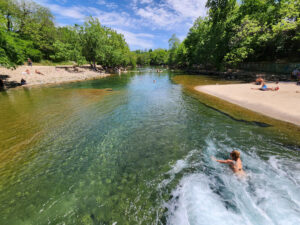
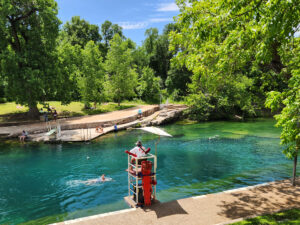
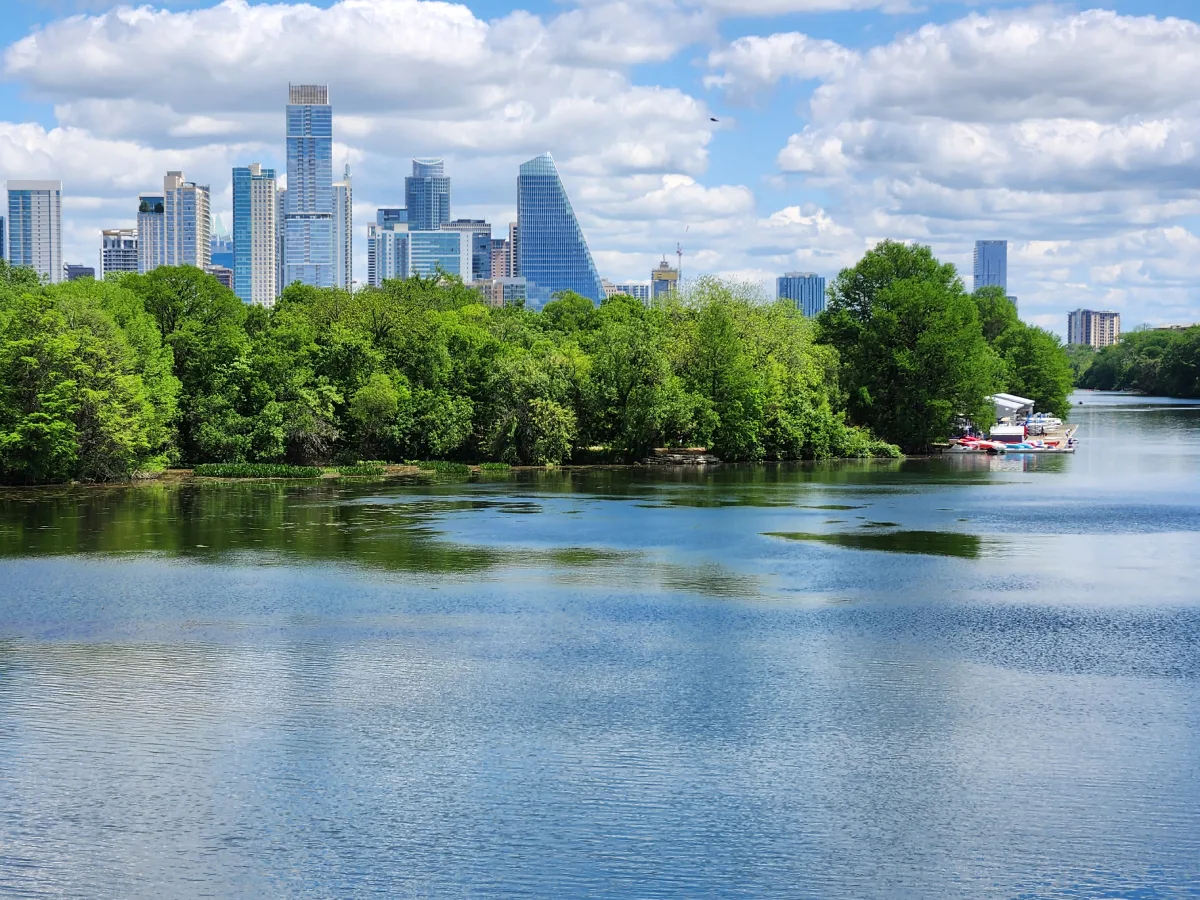
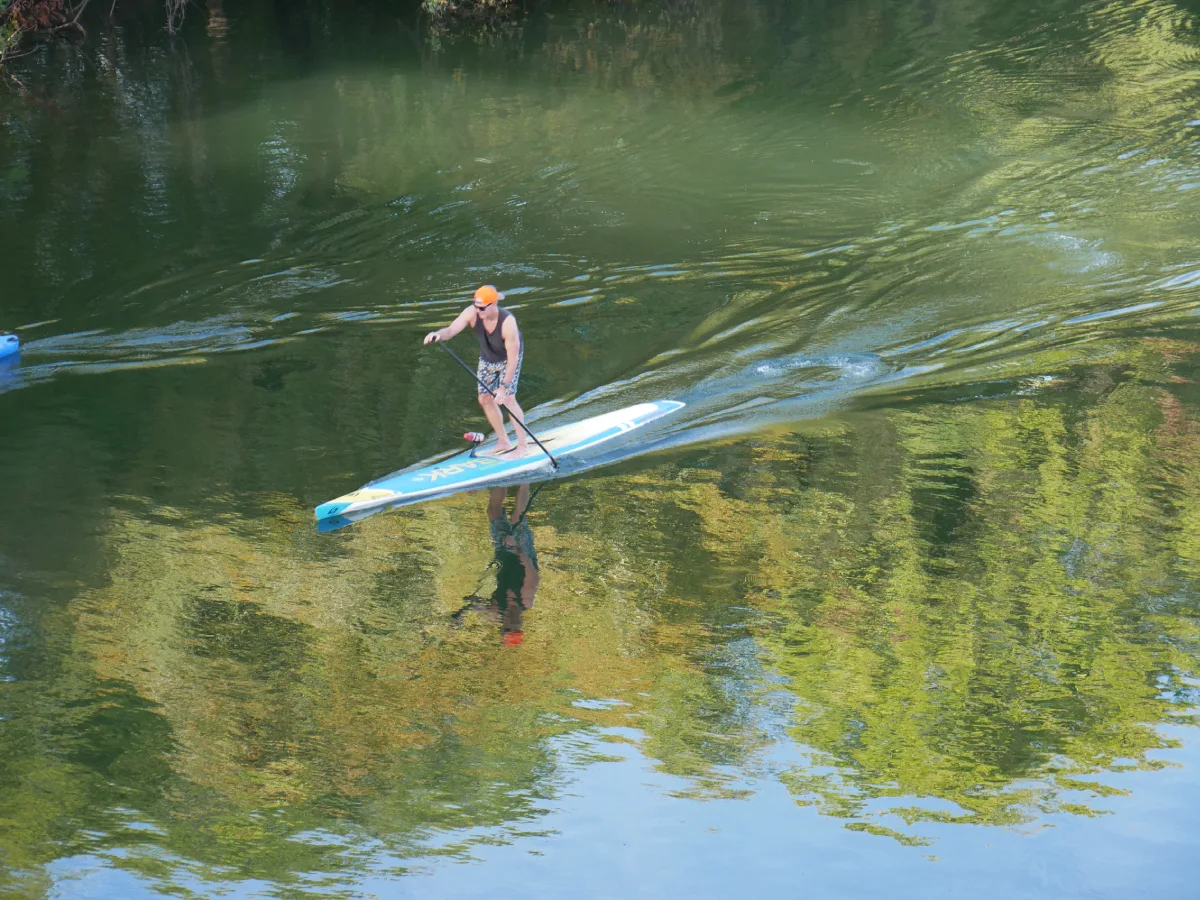
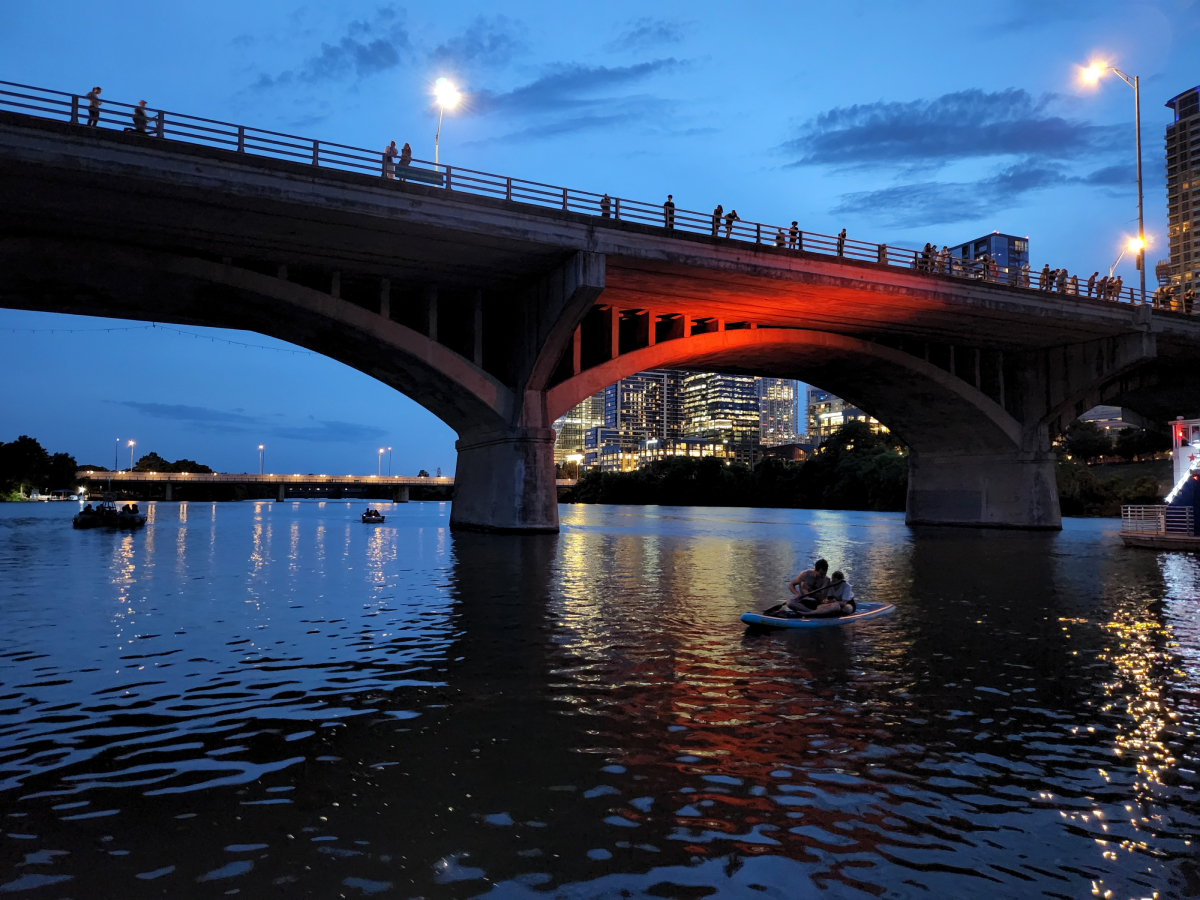
Austin is situated on the Colorado River, with three man-made (artificial) lakes within the city limits: Lady Bird Lake (formerly known as Town Lake), Lake Austin (both created by dams along the Colorado River), and Lake Walter E. Long that is partly used for cooling water for the Decker Power Plant. Additionally, the foot of Lake Travis, including Mansfield Dam, is located within the city's limits. Lady Bird Lake, Lake Austin, and Lake Travis are each on the Colorado River. As a result of its straddling the Balcones Fault, the eastern part of the city is flat, with heavy clay and loam soils, whereas, the western part and western suburbs consist of rolling hills on the edge of the Texas Hill Country. Because the hills to the west are primarily limestone rock with a thin covering of topsoil, portions of the city are frequently subjected to flash floods from the runoff caused by thunderstorms.To help control this runoff and to generate hydroelectric power, the Lower Colorado River Authority operates a series of dams that form the Texas Highland Lakes. The lakes also provide venues for boating, swimming, and other forms of recreation within several parks on the lake shores.

Austin is located at the intersection of four major ecological regions, and is consequently a temperate-to-hot green oasis with a highly variable climate having some characteristics of the desert, the tropics, and a wetter climate. The area is very diverse ecologically and biologically, and is home to a variety of animals and plants. Notably, the area is home to many types of wildflowers that blossom throughout the year but especially in the spring, including the popular bluebonnets, some planted in an effort by "Lady Bird" Johnson, wife of former President Lyndon Johnson.

Austin has a humid subtropical climate, characterized by extremely hot summers with prevailing humid winds from the Gulf of Mexico and mild winters. On average, Austin receives 33.6 inches (853.4 mm) of rain per year, with most of the precipitation in the spring, and a secondary maximum in the fall. During springtime, severe thunderstorms sometimes occur, though tornadoes are rare in the city. Austin is usually at least partially sunny, receiving nearly 2650 hours, or 60.3% of the possible total, of bright sunshine per year.

Austin summers are usually hot and humid, with average July and August highs in the mid-90s. Highs exceed 90 degrees on 109 days per year, and 100 degrees on 12 days a year. The highest recorded temperature was 112 degrees occurring both on September 5, 2000 and also on August 28, 2011.

Winters in Austin are mild and relatively dry. For the entire year, Austin averages 88 days below 45 degrees and 18 days when the minimum temperature falls below freezing. The lowest recorded temperature was −2 degrees on January 31, 1949. Snowfall is rare in Austin, but approximately biannually Austin may suffer an ice storm that freezes roads over and affects much of the city for 24 to 48 hours.

From October 2010 to August 2011, Austin has had the least rainfall since the 1950s. This is a result of La Niña conditions in the Pacific Ocean where water turns unusually cooler than normal. Scientists are still uncertain whether or not these atmospheric phenomena are directly the result of climate change; however, Dr. David Brown, a regional official with the National Oceanic and Atmospheric Administration has explained that "these kinds of droughts will have effects that are even more extreme in the future, given a warming and drying regional climate."

Austin is administered by a city council of seven members, each of them elected at large. The council is composed of six council members, and by an elected mayor, accompanied by a hired city manager under the manager-council system of municipal governance. Council and mayoral elections are non-partisan, with a runoff in case there is no majority winner. Austin remains an anomaly among large Texas cities in that council members are elected on an at-large basis by all voters, as opposed to elections by districts.

Law enforcement in Austin is provided by the Austin Police Department, except for state government buildings, which are patrolled by the Texas Department of Public Safety. Austin was ranked the fifth-safest city in part because there are fewer than five murders per 100,000 people annually. Fire protection is provided by the Austin Fire Department, and emergency medical services are provided by Austin-Travis County Emergency Medical Services.

Austin is known as an oasis of liberal politics in a generally conservative state—so much so, that the city is sometimes sarcastically called the "People's Republic of Austin" by residents of other parts of Texas, and conservatives in the Texas Legislature.

As a result of the major party realignment that began in the 1970s, central Austin became a stronghold of the Democratic Party, while the suburbs tend to vote Republican. Overall, the city is a blend of downtown liberalism and suburban conservatism but leans to the political left as a whole.

The distinguishing political movement of Austin politics has been that of the environmental movement, which spawned the parallel neighborhood movement, then the more recent conservationist movement (as typified by the Hill Country Conservancy), and eventually the current on-going debate about "sense of place" and preserving the Austin quality of life. Much of the so-called environmental movement has matured into a debate on issues related to saving and creating an Austin "sense of place."

Austin is considered to be a major center for high tech.Thousands of graduates each year from the engineering and computer science programs at The University of Texas at Austin provide a steady source of employees that help to fuel Austin's technology and defense industry sectors. The metro Austin area has much lower housing costs than Silicon Valley, but much higher housing costs than many parts of rural Texas. As a result of the high concentration of high-tech companies in the region, Austin was strongly affected by the dot-com boom in the late 1990s and subsequent bust. Austin's largest employers include the Austin Independent School District, the City of Austin, Dell, the U.S. Federal Government, Freescale Semiconductor (spun off from Motorola in 2004), IBM, St. David's Healthcare Partnership, Seton Family of Hospitals, the State of Texas, Texas State University–San Marcos, and The University of Texas. Other high-tech companies with operations in Austin include Nvidia, 3M, Apple Inc., Hewlett-Packard, Google, AMD, Applied Materials, Cirrus Logic, Cisco Systems, eBay/PayPal, Bioware, Blizzard Entertainment, Hoover's, Intel Corporation, National Instruments, Samsung Group, Buffalo Technology, Silicon Laboratories, Oracle Corporation, Hostgator, and United Devices. In 2010, Facebook accepted a grant to build a downtown office that could bring as many as 200 jobs to the city. The proliferation of technology companies has led to the region's nickname, "the Silicon Hills", and spurred development that greatly expanded the city. The concentration of high-tech companies has led the former American Airlines flight between Austin and San Jose, California to be dubbed the "nerd bird."

Austin is also emerging as a hub for pharmaceutical and biotechnology companies; the city is home to about 85 of them. The city was ranked by the Milken Institute as the No.12 biotech and life science center in the United States.

Whole Foods Market (often called just "Whole Foods") is an upscale, national grocery store chain specializing in fresh and packaged food products—many having an organic-/local-/"natural"-theme. It was founded and is headquartered in Austin.

In addition to national and global corporations, Austin features a strong network of independent, unique, locally-owned firms and organizations.


AustinTex.com Logo Link To Home Page